
Challenges of depth in Single-Molecule Localization Microscopy (SMLM)
SMLM provides nanometre-scale information on protein organization by localizing individual fluorophores with high precision.
While SMLM has been widely applied at or near the coverslip, extending it to larger imaging volumes remains difficult due to out-of-focus signal, depth-dependent optical aberrations and mechanical drift.
Improving in-depth SMLM is therefore essential for studying structures located several to tens of microns below the surface, as well as biological processes occurring in these regions, in single cells or 3D cultures.
A method for 3D-SMLM cell reconstruction
In a recent study published in Nature communications, the team of Rémi Galland and Jean-Baptiste Sibarita (Univ. Bordeaux / CNRS) and their collaborators aimed to perform volumetric SMLM with consistent resolution across entire cells.
Their goal was to enable 3D reconstruction of cellular structures while maintaining precise 3D localization at depths reaching several tens of micrometres. The authors tackled the previous challenges of in-depth SMLM using a combination of single-objective light-sheet microscopy to enable optical sectioning, customized SMARt microfabricated devices, Adaptive Optics (AO) for aberration correction & 3D localization, DNA-PAINT, and specialized software. They achieved stable, drift-controlled acquisitions and reconstructed volumes of 10–12 µm thickness with resolutions down to laterally and ~40 nm axially.
Adaptive Optics (AO) as a core component of soSMARt
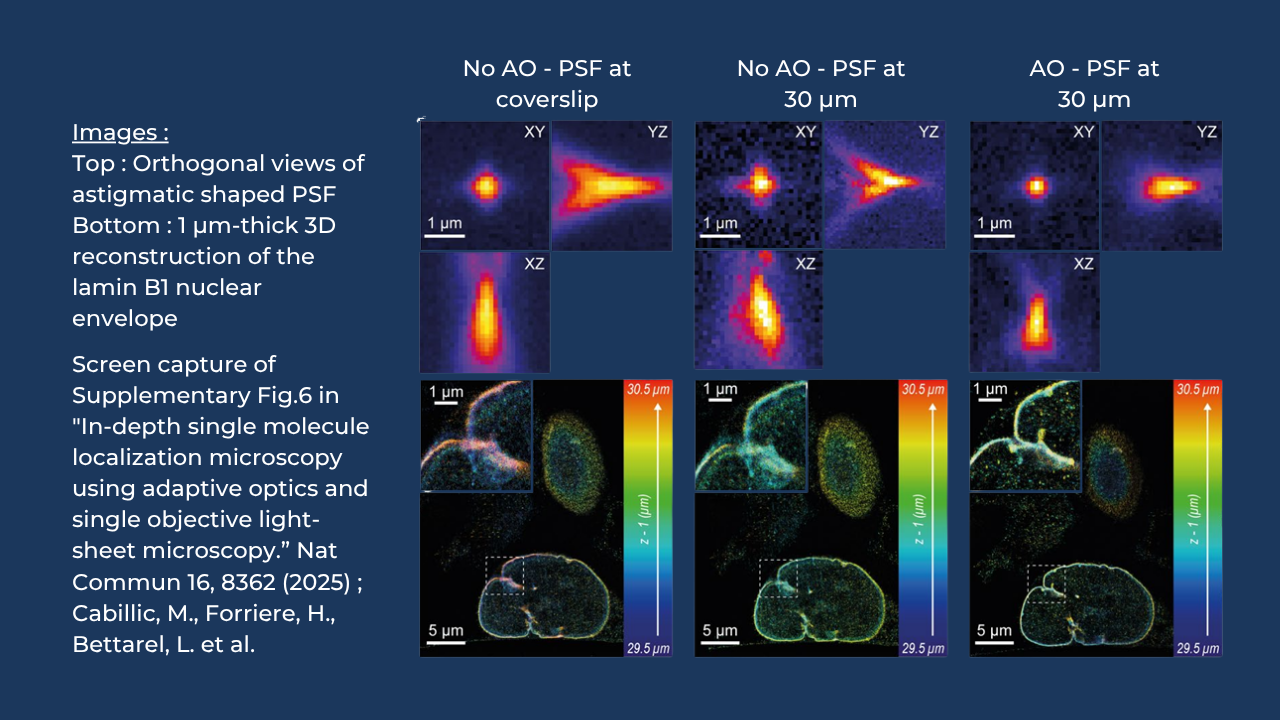
As mentioned above, AO is a central component of the workflow, correcting depth-dependent and preserving the shape of the astigmatic PSF used for 3D localization.
In their soSMARt method, the researchers integrated and used the MicAO module, based on a Mirao deformable mirror, to perform iterative aberration correction using a sensorless AO approach. MicAO is an AO add-on enabling system and depth-induced aberration correction, accurate 3D localization through PSF shaping, while maintaining PSF stability during long acquisitions.