
Understanding Adaptive Optics (AO)
one layer at a time, a guide

The basics

Practical implementation

Applications
Adaptive optics is a technique that improves how we see. It works by correcting distortions, those small shifts in light that can blur what we observe, whether through a telescope or a microscope.
This page offers a non-exhaustive overview of what adaptive optics is, how it works, and where it’s used. We’ll look at its key components, some of its variations, and its main applications, especially in imaging, where we work most closely with it.
What is Adaptive Optics ?
Adaptive Optics (AO) is a technique to measure and correct distortions in light wavefronts (also called aberrations), restoring image quality as light travels through imperfect optics or tissues.
Understanding Light and Aberrations
Light travels in wavefronts, surfaces connecting points of the same phase. In an ideal system, these wavefronts are flat. You could picture it as the still surface of water in a glass. But as light passes through imperfect optics, biological tissues, or the Earth’s atmosphere, it gets distorted; just like when you drop a small bead of water into that glass and ripples spread outward, wrinkling the surface. These distortions are known as aberrations, and they degrade image quality, especially in high-resolution imaging systems.
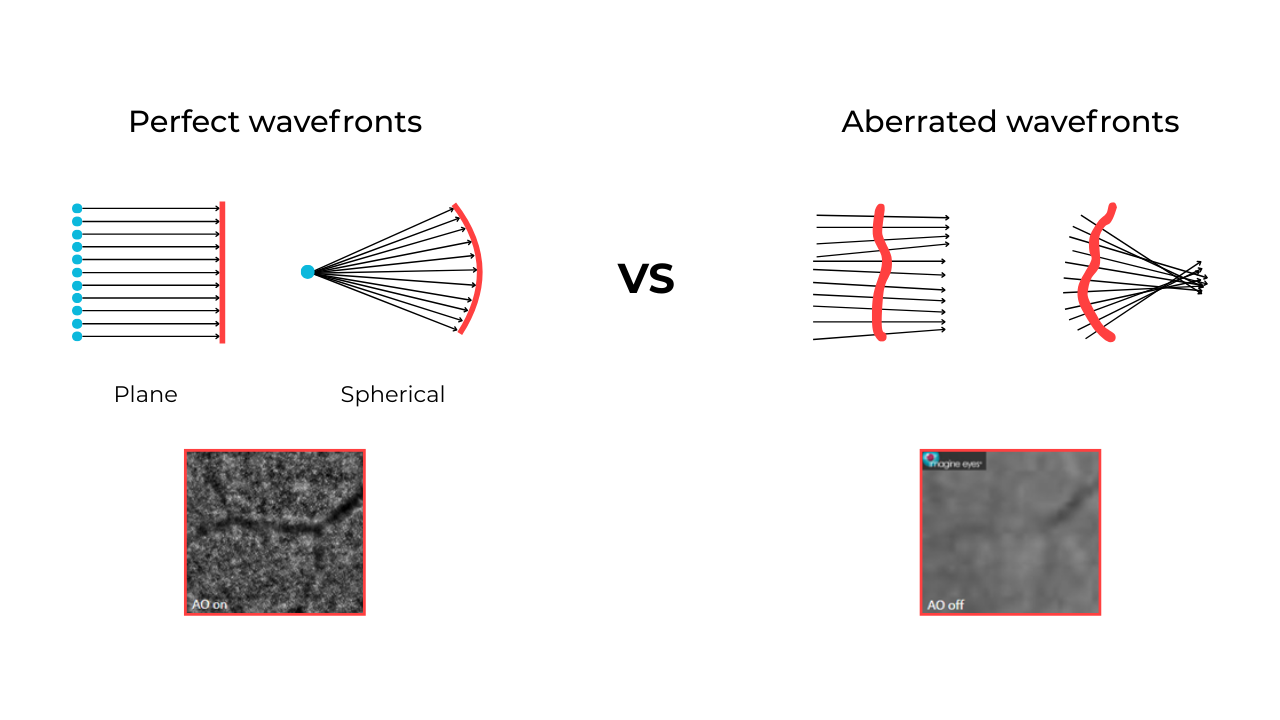
In biological imaging, such light deviations come from refractive index variations, whether it is between the objective lens immersion medium and the specimen or between different regions of the specimen itself. It is typically something you can observe when you put a straw in water and it seems to be cut: there is a mismatch in refractive index between air and water.
The internal heterogeneity causes light to scatter as it travels through a sample, especially in live specimens or thick tissues: going deeper in a sample usually means getting more aberrations, and more complex ones. [1]
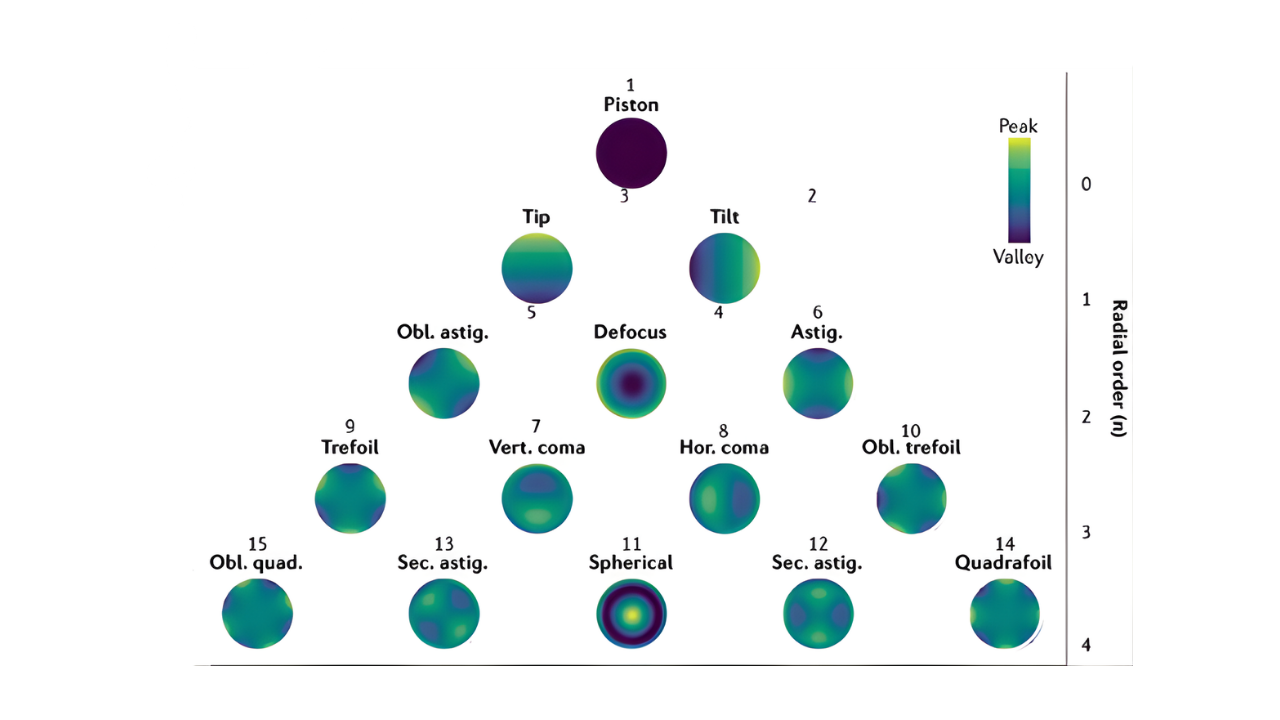
To describe these distortions in a simple and intuitive way, the resulting deformation of the light wavefront is often broken down into a set of standard aberration patterns, such as defocus, astigmatism, or spherical aberration. This description is commonly based on Zernike polynomials, which provide a convenient framework to quantify and compare aberrations induced by the specimen without requiring an in-depth background in optics.
Resolution and Performance Metrics
In imaging, resolution refers to the smallest spatial detail that can be distinguished in an image. If a system can image with a high resolution, it means that it can distinguish very well between closely spaced points. This distinction relies on how the system’s PSF (Point Spread Function) is narrow: it is the image formed by an optical system of a single point source. In a perfect system, the PSF should look like a round point with defined edges, but when aberrations appear it spreads, gets distorted and blurry.
Adaptive optics aims to correct aberrations and restore the PSF as close as possible to its ideal form.

Performance in adaptive optics is often evaluated using complementary metrics:
- Signal-to-Noise Ratio (SNR): It is influenced by how sharp the PSF is and the amount of noise around. SNR measures how much a meaningful signal stands out relative to the background noise. It is particularly crucial in low-light or photon-limited conditions, such as in fluorescence microscopy or live-cell imaging, where preserving signal fidelity is more important than achieving ultimate resolution.
- Strehl Ratio: This is the ratio of the peak intensity of the corrected image to that of an ideal (diffraction-limited) system or, in other words, a comparison of PSF’s peak intensity with and without aberrations. It reflects how closely the optical system performs compared to a perfect system. A Strehl ratio close to 1 indicates excellent correction.
Which metric to prioritize depending on the application?
- If you need to distinguish fine structural details (e.g., identifying organelle morphology), resolution is key.
- In sensitive fluorescence experiments where signal levels are low, boosting the SNR can have a greater impact than resolving slightly finer details.
The Strehl ratio is often used in systems like astronomy or ophthalmology to assess overall correction quality when a direct resolution or SNR improvement is harder to quantify.
General Principle of Adaptive Optics
Adaptive optics systems typically operate in three main steps:
- Aberration estimation
- Computation of a corrective phase map, based either on direct measurements or indirect estimations
- Correction

How to implement Adaptive Optics ?
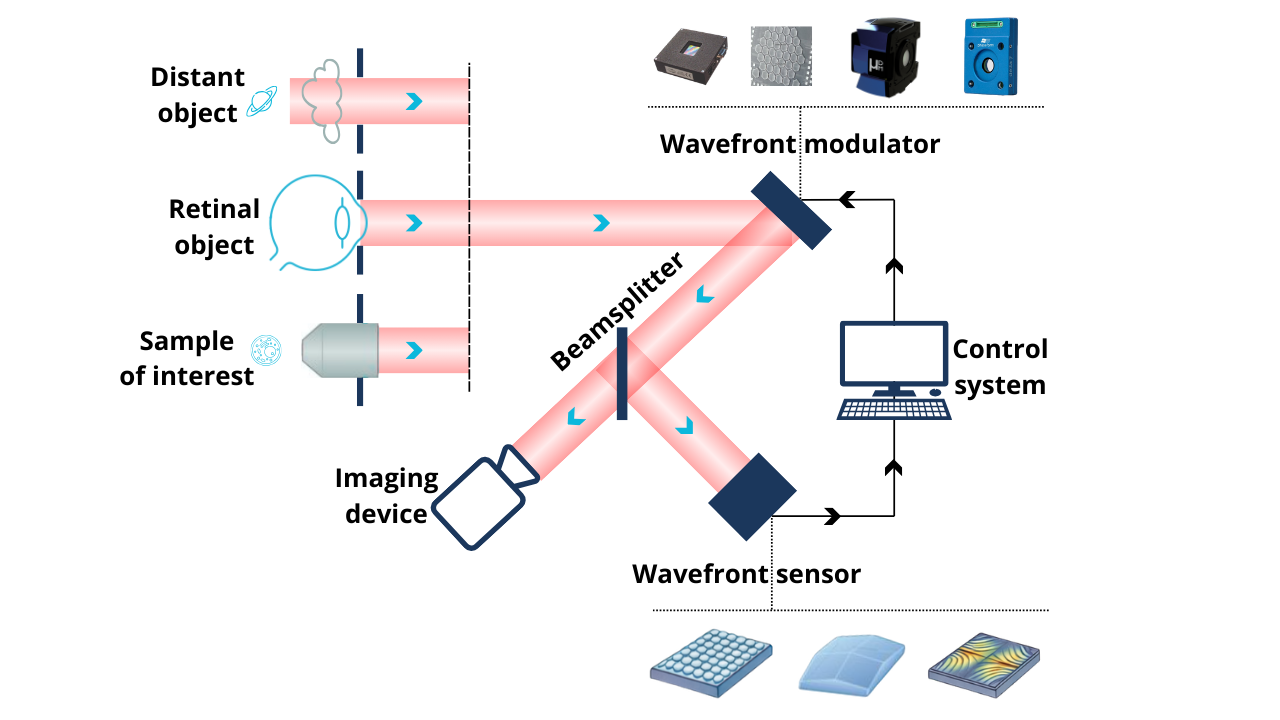
Adaptive optics systems are usually built with 3 “types” of components: a wavefront modulator, a wavefront sensor and a control system to run both. Many implementation methods exist and choosing the right configuration depends on both technical constraints and application goals.
Key Components
1) Wavefront Modulators
These devices correct the incoming distorted wavefront:
-
- Deformable Mirrors (DMs): Continuous faceplate mirrors use actuators under a flexible surface.
- Segmented mirrors (often MEMS-based) adjust each segment independently.
- Spatial Light Modulators (SLMs): Modify the phase of light using liquid crystals or micro-mirrors.
- Deformable Lenses: Change their shape or refractive index to adapt focus and correct aberrations.
-
- Shack–Hartmann Sensor: Divides the incoming wavefront using a microlens array. The positions of the focused spots reveal wavefront slopes.
- Pyramid Wavefront Sensor: Splits light into four beams to infer local phase changes, offering higher sensitivity in certain conditions.
- Quadriwave Lateral Shearing Interferometry (QWLSI): Uses diffraction to detect wavefront gradients without moving parts. [2]
3) Control System
The control system connects the sensor to the modulator, calculating real-time corrections. This involves:
-
- High-speed computation
- Calibration algorithms
- Synchronization with imaging systems
Aberration detection methods
Closed-loop systems:
Measure and correct in real time. Most commonly used.

Open-loop systems:
Apply known corrections without real-time feedback. Useful when sensors are hard to implement.
-
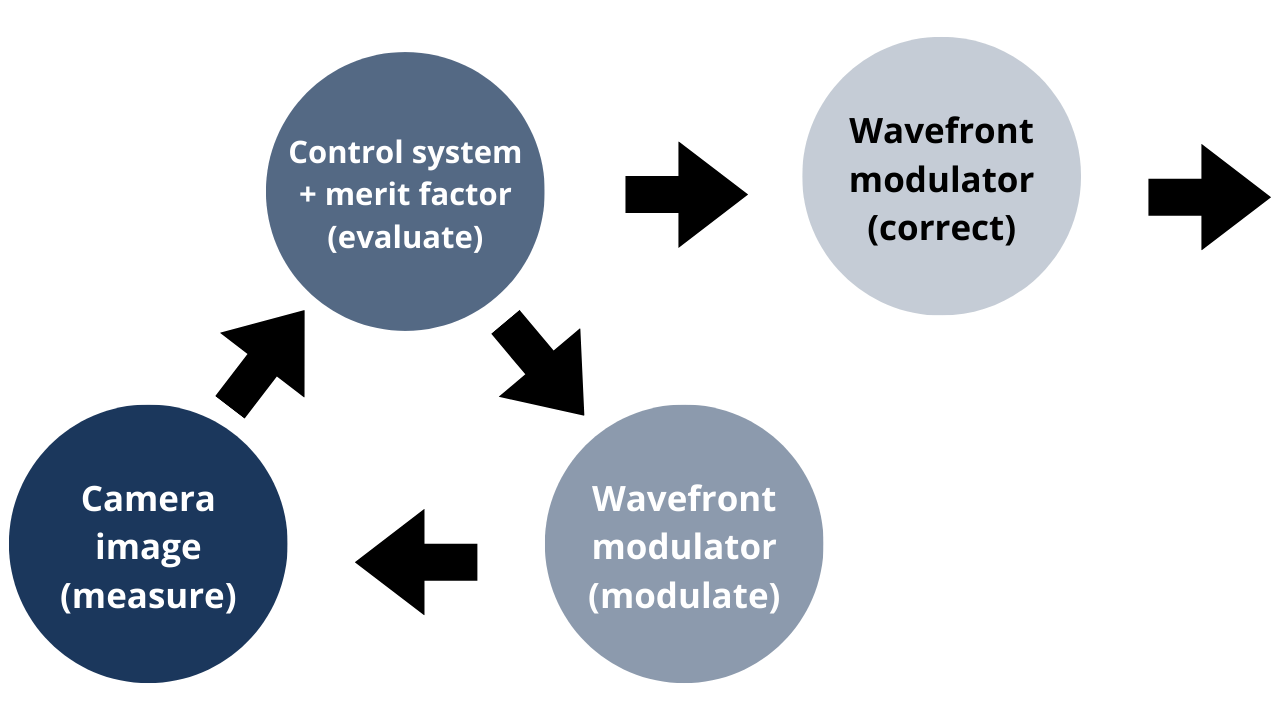
- Sensorless AO: Use image quality metrics instead of a physical wavefront sensor.
Open-loop systems:
Apply known corrections without real-time feedback. Useful when sensors are hard to implement.
- Model-based & Digital AO: Employ physical models or simulations to estimate and correct wavefronts.
- AI-based AO: Machine learning models predict distortions and generate corrections, especially useful in complex biological samples.

In methods like closed-loop, and sensorless adaptive optics, phase corrections are physically applied to the light path. We talk about wavefront shaping, a technique implying to deliberately control the phase of the light field using a physical modulator, such as a deformable mirror or spatial light modulator.
In contrast, model-based, digital, and AI-driven approaches may bypass physical wavefront shaping altogether, applying corrections numerically to the acquired image or using predictive algorithms to enhance image quality post-acquisition.
Some advanced implementations blend strategies, for instance, combining model-based predictions with image-based feedback.
Where to use Adaptive Optics ?
AO can be used in many fields that require controlling or shaping light wavefronts, either to correct aberrations or to impose a desired form onto the light. Below are a few examples:
CD/DVD Readers

One of the earliest practical uses of AO were simple feedback systems correct, for disc wobble or surface imperfections, to keep the laser focused.
Laser Systems & Optical Communications

AO maintains beam focus over long distances or through turbulent media, essential for laser machining, free-space optical communications, and LIDAR.
Defense & Surveillance

AO enhances visual systems for drones, satellite imaging, or long-range surveillance, especially in dynamic environments.
Astronomy

Adaptive optics corrects atmospheric turbulence in real-time, enabling ground-based telescopes to reach space-level image quality.
Systems often use Shack-Hartmann sensors and guide stars (natural or laser-generated). [3]
Ophthalmology

AO systems are used in retinal imaging to correct the eye’s natural aberrations. This allows detailed visualization of individual cells in the retina.
Microscopy (Our Core Focus)
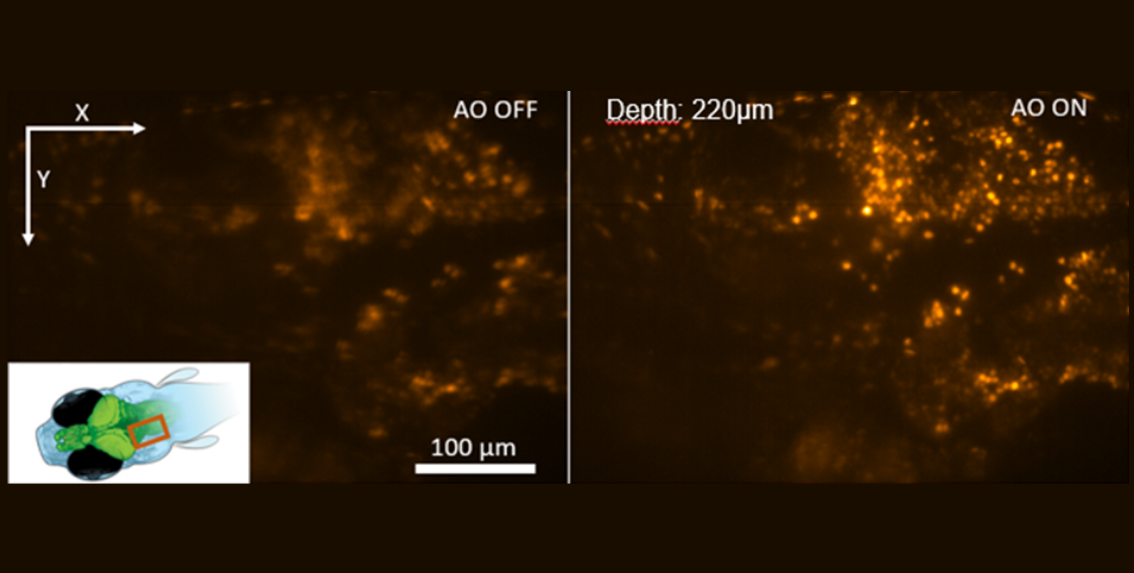
In biological imaging, adaptive optics allows researchers to:
-> Correct tissue-induced aberrations
-> Improve resolution
-> Boost fluorescence
-> Image deeper
-> Reduce excitation power
AO is particularly impactful in deep tissue imaging, where sample heterogeneity significantly distorts the wavefront. [4]
Other application fields

Quantum optics: Where precise wavefront control is needed.
3D printing: For precise laser beam shaping in photopolymerization.
Holography: Improving phase fidelity.
Bibliography
[1] AO Microscopy. (n.d.). Basic introduction to adaptive optics
[2] Phasics. (n.d.). Unique wavefront sensing technology
[3] Wikipedia contributors. (n.d.). Adaptive optics. Wikipedia
[4] PubMed Central (PMC). (2020). Recent advances in adaptive optics for biological imaging. Frontiers in Physics
You can also check Axiom Optics. (n.d.). Adaptive optics